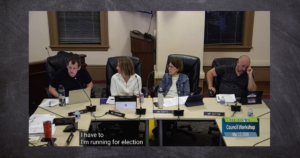
Councilwoman Samantha D’Eramo has finally recused herself from the Canterbury Meadows matter. After sustained public scrutiny, she stepped back from a settlement process she had already sat through in multiple executive sessions on the matter. The reason for her conflict is that her brother is a law partner at the firm representing the party suing the City of Hudson. Her brother, Patrick Clunk even attended her swearing in.
A Family Affair: D’Eramo’s Brother and Kowalski’s Husband Work at the Firm Suing Hudson
That fact was not newly discovered this week. Residents and observers had been asking about conflicts of interest around the litigation and the proposed 32-lot settlement on the nearly 95-acre Ravenna Street and Stow Road property for weeks. Campaign contribution to D’Eramo, Amanda Weinstein, and Kyle Brezovec from the developer had already been raised publicly. Her brother is a partner at the law firm suing the city added a direct family financial and professional stake in the outcome of litigation against the city she serves.
Recusal after the fact is not the same as avoiding the conflict in the first place. She already has the information she should never have been privy to. Councilor Skylar Sutton is a property owner adjacent to this land. He recused himself from the start. D’Eramo did not.
Confidential When Convenient
In the same period, D’Eramo stated that executive sessions are confidential. She made that statement after having participated in several of them concerning the Canterbury Meadows settlement discussions. She also made it after she voted to remove the prior censure of Nicole Kowalski for sharing privileged information – the same type of information D’Eramo has already received and claims is never shared.
That censure had centered on allegations that Kowalski disclosed materials protected by attorney-client privilege and executive-session confidentiality. D’Eramo voted to remove that censure – signaling that she finds it acceptable breaking attorney-client privilege.
The sequence is straightforward. Participate in closed sessions on a high-stakes development settlement in which her brother’s firm has a role, then publicly assert the confidentiality of those sessions, after having voted to clear a colleague previously censured for breaching the same category of privilege.
Selective Rules
Executive session confidentiality and attorney-client privilege exist to protect the city’s legal position and taxpayer interests during active litigation. They are not optional for some members and mandatory for others. When a council member has already sat in multiple closed sessions on a matter involving a relative’s law firm, then invokes confidentiality only after public pressure forces a late recusal, residents are entitled to ask what information was already discussed, what advice was received, and whether the city’s negotiating posture was shaped by someone who should have stepped aside earlier.
The Canterbury Meadows settlement itself remains controversial. Residents have raised charter questions about bypassing Planning Commission processes, open-space and drainage impacts, and the wisdom of resolving multi-million-dollar claims via a deal that still leaves final technical review largely with staff. Outside counsel and mediation produced the proposed terms. Those terms were developed while at least one council member with a familial connection to opposing counsel remained in the room for closed discussions.
What Comes Next
D’Eramo’s recusal is late, but it is now on the record. The remaining council members must still vote on whether to approve the settlement. The public record should include a clear accounting of which executive sessions addressed the matter, whether any privileged advice or strategy discussions occurred while the conflicted member was present, and how the city intends to handle similar family or business conflicts going forward.
Rules on confidentiality and privilege are either real or they are not. They cannot be enforced against one member while another participates in the same closed process, then cites those rules only after the conflict becomes public.
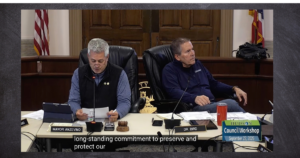
You can watch Samantha D’Eramo’s statement below. Notice how she takes a page out of the Weinstein book by attempting to portray herself as a victim. But, the real victim here are the residents of Hudson who will be negatively impacted by this development which was already rejected by BZBA, Planning Commission, previous council, and the court.
A reader sent in tip that it was well known that Tucker Ellis (the law firm where her brother is a partner) was representing the plaintiffs suing the city. It was even documented in the media. She cannot claim ignorance or blame city staff. She either is incompetent or corrupt. Those are the two options for D’Eramo on this matter. She has a responsibility to do her due diligence and she failed her constituents.
Unfortunately, Hudson taxpayers will likely get a huge legal bill because of her corruption or incompetence,